Inshore Thinking: A Smarter Way to Fish the Georgia & Northeast Florida Coast
INSHORE THINKING: A SMARTER WAY TO FISH THE GEORGIA & NORTHEAST FLORIDA COAST
Fishing the coast can be humbling.
You can have the right rod, the right lure, the right tide chart and a spot that produced fish yesterday—and still come up empty.
That's because successful inshore fishing isn't simply about knowing what to throw.
It's about understanding why fish are where they are in the first place.
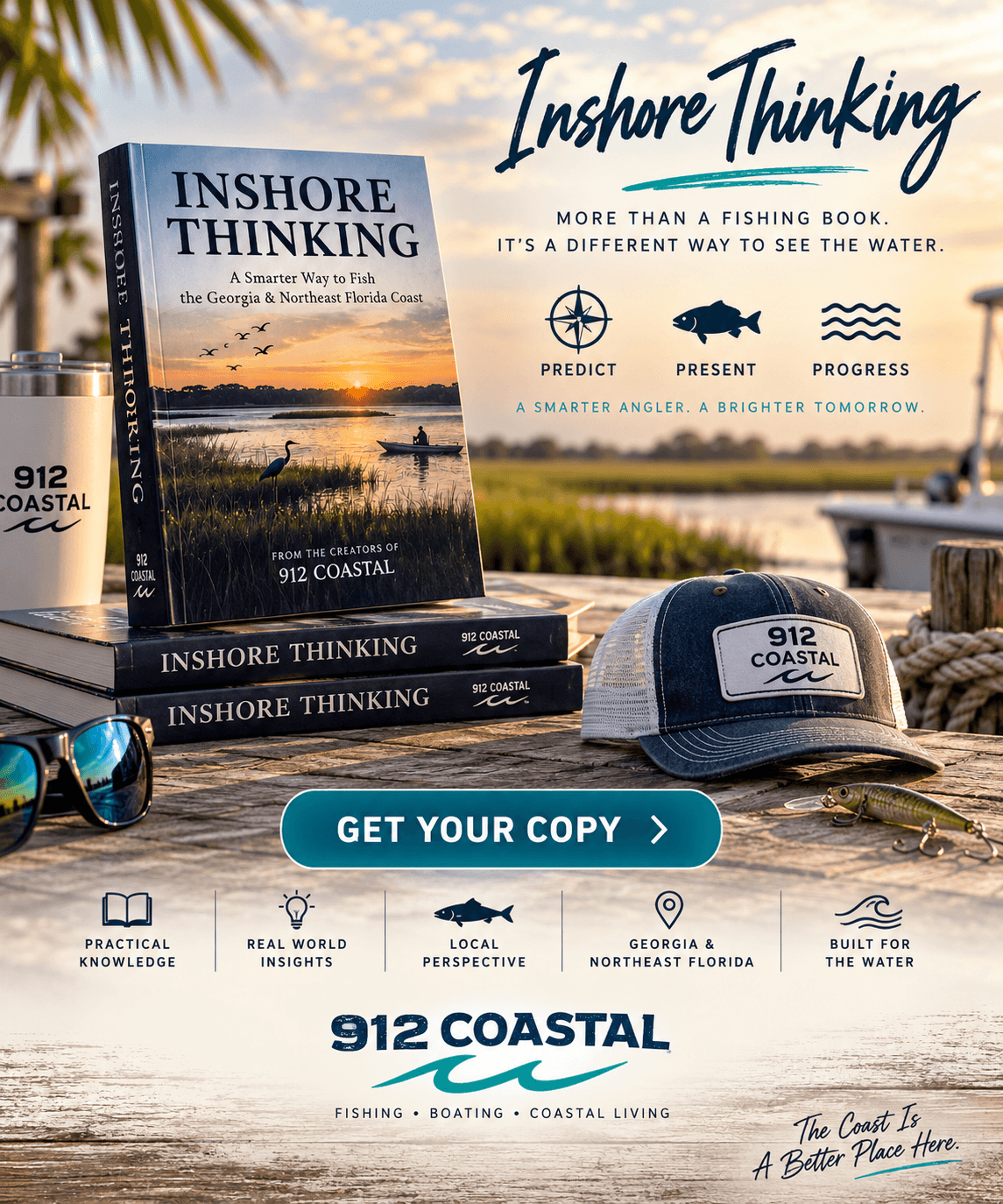
That's the idea behind Inshore Thinking, the newest fishing guide from 912 Coastal.
It isn't designed to give you a magic lure, a list of secret spots or a handful of rules that supposedly work every time.
It's designed to teach you how to read the water, recognize patterns, make better decisions and adjust when the conditions change.
The philosophy comes directly from the book:
Learn the water first. Learn why something works before buying another piece of gear.
The goal isn't to memorize the coast.
The goal is to learn how to understand it.
FISHING IS MORE THAN KNOWING WHAT TO THROW
A new rod.
A different reel.
Another box of lures.
A new color because somebody caught three fish on it last weekend.
Gear certainly has a place. But gear doesn't tell you where the fish should be.
The coast does.
Inshore fishing is a constantly changing system of tides, current, structure, forage, weather, water temperature and water clarity.
When those pieces change, fish can change with them.
That means the same location can fish completely differently from one day to the next.
Inshore Thinking approaches fishing from that perspective: understand the system first, then choose the technique and equipment that make sense for the situation.
LEARN TO READ THE COAST BEFORE YOU READ THE TACKLE BOX
Before making that first cast, stop and look.
What is the water doing?
Where is it moving?
Where does shallow water meet deeper water?
Where are the creek mouths, drains, oyster edges, points, docks and current seams?
And perhaps the most important question:
Where would the water put the food?
Those observations can tell you more than simply knowing the name of the place you're fishing.
Inshore fish aren't randomly distributed.
They have reasons for being somewhere.
Structure can provide protection.
Current can deliver food.
Shallow areas can warm or cool.
Drains can funnel water and forage.
Creek mouths can concentrate movement.
The angler's job is to recognize those relationships.
THE TIDE IS MORE THAN A TIME ON A CHART
A tide chart gives you information.
But it doesn't fish for you.
One of the central ideas in Inshore Thinking is learning to connect the predicted tide to what is actually happening on the water.
The important question isn't simply:
“Is it high tide or low tide?”
Instead ask:
How much water is moving? Where is it moving? And what is that movement doing to the fish and their food?
Tidal range matters because it determines how much water is moving through the system. A larger movement can concentrate forage into drains, creek mouths and other funnel points, while weaker movement can leave fish more spread out.
That makes the tide chart a starting hypothesis, not a command.
Two locations can experience the same tide cycle and still fish completely differently because channels, wind, structure and shoreline shape change the way water actually moves.
That's a much more useful way to think about tides.
FIND THE FOOD, AND YOU START FINDING THE FISH
Fish need to eat.
That sounds obvious, but it can completely change the way you approach an inshore fishing trip.
Instead of immediately asking:
“What lure should I throw?”
Ask:
“What would a fish actually be eating here right now?”
Shrimp, baitfish and crabs use structure for food and protection. That puts them around many of the same areas predators use to hunt—current seams, shell, grass edges, docks and drains.
Look for clues.
Are baitfish moving?
Are shrimp being pushed through a drain?
Are crabs exposed around shell?
Are birds showing activity?
Is current concentrating forage along an edge?
You aren't necessarily looking for a guarantee.
You're looking for a reason for a predator to be there.
That shift—from chasing a remembered fishing spot to following the food—is one of the biggest changes an angler can make.
KNOW THE FISH—BUT DON'T LET THE FISH DO YOUR THINKING
Knowing how redfish, trout, flounder, drum, sheepshead and other inshore species behave is valuable.
But species information should be a starting point.
Not a guarantee.
A redfish may use shallow flats, drains, oyster edges and creek mouths.
A trout may change depth as conditions change.
Flounder may position differently from the predators you're accustomed to targeting.
The important thing is not simply memorizing where a species “likes” to be.
It's understanding why it would be there under the conditions you're facing today.
That's why Inshore Thinking repeatedly comes back to observation and adjustment.
Let the water confirm your theory—or prove it wrong.
GEORGIA AND NORTHEAST FLORIDA ARE THE PERFECT CLASSROOM
The Georgia and Northeast Florida coast provides an incredible environment for learning this approach.
Georgia's coastline is heavily influenced by tidal movement, salt marsh, winding creeks, oyster habitat and river influence.
Large areas of marsh can look almost identical from a distance, while relatively small differences in depth and drainage can create very different fishing opportunities.
Northeast Florida adds another layer.
Tidal creeks, rivers, the Intracoastal Waterway and more open coastal water can behave differently—even during the same trip.
Rain can change freshwater flow, salinity and water color.
Wind can completely change how a shoreline fishes.
A pattern that works in a protected creek in the morning may need to be adjusted when you reach more exposed water later in the day.
That's exactly why learning a process is more valuable than memorizing a list of spots.
FISHING SMARTER MEANS ADJUSTING
One of the biggest differences between struggling and improving as an angler is what happens after the first plan doesn't work.
Do you keep throwing the same lure?
Keep fishing the same depth?
Keep sitting on the same spot because it produced last week?
Or do you ask what changed?
Maybe the tide isn't moving the way you expected.
Maybe the wind changed the shoreline.
Maybe the water temperature shifted.
Maybe the bait moved.
Maybe the fish simply aren't positioned where they were yesterday.
The answer isn't always to completely change everything.
Sometimes you only need to change one variable at a time.
Depth.
Retrieve speed.
Presentation.
Position.
Location.
Tackle.
That allows you to learn from each cast instead of simply making more casts.
THIS IS WHERE THE “THINKING” COMES IN
The name Inshore Thinking isn't about making fishing complicated.
It's actually about making it simpler.
Instead of carrying dozens of disconnected fishing rules around in your head, you begin looking for relationships.
Tide → Current → Forage → Fish
Structure → Current → Ambush Opportunity
Weather → Water Conditions → Fish Position
Observation → Prediction → Cast → Adjustment
That becomes a repeatable process.
And once you learn that process, it can travel with you.
That's important because the coast doesn't always look familiar.
A new creek.
A new marsh.
A new pier.
A different section of the Intracoastal.
A different state.
The more you understand the underlying system, the less dependent you become on already knowing the exact spot.
The book specifically approaches unfamiliar water as a diagnostic process:
study habitat, tide, conditions, forage and fish position rather than expecting local knowledge to magically appear.
MORE THAN A FISHING BOOK
Inshore Thinking is a fishing guide, but its purpose goes beyond simply catching more fish.
It's about becoming more observant.
Learning the water.
Understanding why a location works.
Making predictions.
Testing those predictions.
Keeping what works.
Changing what doesn't.
The book's philosophy is simple: you don't need to know everything before launching the kayak, stepping onto the pier or making your first cast.
You need to be willing to learn what the water is telling you.
That's the difference between simply fishing a location and learning a fishery.
WHO IS INSHORE THINKING FOR?
It's for the angler who is just getting started and doesn't know where to begin.
It's for the freshwater angler learning saltwater.
It's for the kayak angler trying to understand positioning, current and structure.
It's for the boat angler who wants to make better decisions before moving from spot to spot.
It's for the pier and bridge angler trying to understand current and presentation.
And it's for the experienced angler who already catches fish but wants to become better at understanding why those fish were there.
Because the goal isn't to make every trip perfect.
The goal is to make every trip teach you something.
START THINKING LIKE AN INSHORE ANGLER
The next time you reach the water, don't immediately pick up your rod.
Take five minutes.
Look.
Watch the surface.
Look for bait.
Find the current.
Notice the water color.
Look at the shoreline.
Then make a prediction.
Where should the food be?
Where should the fish be?
Why?
Then make your first cast.
If you're right, you've learned something.
If you're wrong, you've learned something too.
That's Inshore Thinking.
It's not about having every answer before you start.
It's about knowing how to find the answer once you're on the water.
And that is the system behind 912 Coastal's approach to fishing smarter along the Georgia and Northeast Florida coast.
The book's closing message brings the philosophy back to the same idea: the water changes, the tide changes, the bait moves, the fish adjust—and the angler should adjust too.
PREDICT • PRESENT • PROGRESS
OBSERVATION • UNDERSTANDING • CONFIDENCE
Your System for Inshore Success.
The system starts here. 912 Coastal.
EXPLORE MORE 912 COASTAL
If you're learning to fish the Georgia and Northeast Florida coast, keep exploring:
Fishing Tips — practical inshore fishing knowledge and techniques
St. Marys Fishing — local fishing information for the St. Marys area
Fishing Reports — see what anglers are finding on the water
Kayaking — explore the coast from a different perspective
Boating — learn more about getting on the water and finding productive areas
Gear Reviews — understand the equipment that can support your fishing
Fishing Charters & Trips — discover more ways to experience the coast
And if you want to take the thinking with you on the water, Inshore Thinking is where the system starts.
ABOUT 912 COASTAL
912 Coastal is your home for fishing, boating, and coastal living across Georgia and Northeast Florida. Discover local fishing reports, gear reviews, guides, and coastal adventures.
Tight lines, and welcome to the 912 Coastal community!


Join thousands of anglers and get fishing tips, local reports, new blog posts, gear recommendations, and exclusive 912 Coastal updates delivered to your inbox.