Inshore Fishing 101: Everything You Need to Know to Get Started
Inshore Fishing 101: Everything You Need to Know to Get Started
Inshore fishing is saltwater fishing that happens close to shore, in relatively calm coastal waters, where you can target a surprising variety of fish without heading miles offshore.
For anglers along the Georgia and Northeast Florida coast, inshore fishing is especially accessible. Tidal creeks, marshes, flats, rivers, sounds, docks, beaches, and backwater areas create an enormous variety of places to fish — often without traveling far from home.
And that's what makes it so appealing.
You don't need a massive offshore boat. You don't need to run 20 miles out into the ocean. You don't even need a boat at all.
You can fish from a boat, kayak, bank, pier, dock, jetty, or beach. You can fish a tidal creek in the morning, work a shoreline from a kayak in the afternoon, or stand in the surf and make a few casts before dinner.
And the fish can be anything but small. Depending on where you are and what conditions you're dealing with, inshore waters can put you around redfish, trout, sheepshead, flounder, black drum, sharks, and many other species.
That's inshore fishing. But there's more to it than simply being close to land — the real fun begins when you start understanding why fish are there.
What Exactly Counts as Inshore Fishing?
The easiest way to think about it: inshore fishing is saltwater fishing in relatively calm coastal waters close to shore, rather than heading miles offshore into the open ocean.
That can include bays, estuaries, sounds, tidal rivers, creeks, flats, marshes, channels, and other nearshore waters. It can also include fishing around docks, bridges, jetties, piers, and shorelines. Surf fishing from the beach counts too.
There isn't a single piece of equipment that makes something "inshore fishing." There isn't one specific fish you have to catch. And there isn't one type of angler who belongs here. You can be an experienced angler in a center console one day and a beginner standing on a public pier the next — you're still fishing the same basic coastal system.
You Don't Have to Go Offshore to Catch Big Fish
When people hear saltwater fishing, they sometimes picture a boat disappearing toward the horizon. That's offshore fishing. Inshore fishing brings the action much closer.
You could be fishing a shoreline and hook into a hard-fighting redfish. You could be working a dock and find sheepshead around the structure. You could be casting a soft plastic for trout along a deeper edge. Or you could be standing on the beach and suddenly realize the fish you're looking for are much closer than you expected.
And sharks? You don't have to travel 20 miles offshore to catch one — some coastal and inshore environments hold surprisingly large sharks. That unpredictability is part of what makes inshore fishing so accessible and exciting.
Ways to Fish Inshore
This might be the biggest reason people get hooked on inshore fishing: you don't have to own a boat.
From a Boat — Covers more water and lets you explore different creeks, flats, shorelines, channels, and structure.
From a Kayak — Gets you into shallow areas and smaller waterways larger boats can't reach, and puts you right at water level.
From the Bank — Sometimes all you need is a piece of accessible shoreline and a rod. Creek banks, riverbanks, and public access areas can be productive water.
From a Pier — Gives anglers access to deeper water without a boat, and is a great place for beginners to start learning saltwater fishing.
From a Dock — Provides structure, shade, and changes in water depth that attract fish.
From a Jetty — Interrupts moving water and creates structure and current breaks.
From the Beach — Surf fishing puts you directly on the edge of the coastal environment, and you'll be surprised how much you can learn just by watching the water.
Inshore fishing doesn't require a boat. It requires access to water and a willingness to learn what that water is doing.
How to Find the Fish
A beginner might look at a stretch of water and think, "Where do I cast?" An experienced angler is more likely to think, "Why would a fish be here?" That's a completely different way of looking at fishing.
Fish don't spread themselves evenly across every foot of water — they have reasons for being where they are. Maybe there's food nearby. Maybe there's deeper water close by. Maybe there's structure. Maybe the current is bringing something to them, or the tide has just opened access to an area that wasn't available a few hours earlier. Maybe a point creates a perfect ambush location.
Start looking at the water differently. Take a shoreline — at first it might look like nothing more than a shoreline. But look closer: Is there a creek entering the larger body of water? Is there a bend? Does the bottom get deeper? Is there an oyster bar, grass, a dock, a point sticking into the current, a place where shallow meets deep? Now you're seeing possibilities. Stop looking at the water as one giant fishing spot — start breaking it into pieces.
Why the Tide Changes Everything
Inshore fishing is heavily influenced by tides because tides move water through the coastal environment, and when water moves, things happen. Bait moves. Shrimp move. Crabs move. Small fish move. Predators notice.
An area that seems quiet during one part of the tide can become much more interesting when water begins flowing across it. That's why two anglers can fish the exact same spot on the same day and have completely different results — one arrives when the water is barely moving, the other when the current is flowing. Same location, different conditions, completely different fishing.
You don't have to become a tidal scientist. Just start paying attention: What was the tide doing when you caught fish? What was it doing when you didn't? Over time those observations become patterns.
Look for the Food
Here's a simple rule that makes a huge difference: find the food and you may find the fish.
Inshore predators have to eat — shrimp, mullet, menhaden, smaller baitfish, crabs, or other forage. Watch the water. Do you see bait moving? Nervous water? Are birds working? Is bait being pushed along a shoreline? Is water draining from a creek? Those are all clues. You don't necessarily need to see the fish — sometimes you just need to find the reason the fish should be there.
Structure Gives Fish a Reason to Stop
Fish don't always want to swim around in open water looking for dinner. Structure gives them an advantage: a dock piling, an oyster bar, a bridge, a jetty, a grass edge, a point, a deeper hole beside shallow water. These places provide cover, food, and ambush opportunities.
Important lesson: structure isn't always something sticking out of the water. Some of the most important structure is underwater — which is why learning to read shoreline, depth, and current matters as much as having a good lure.
What Fish Can You Catch Inshore?
That's one of the best questions in inshore fishing, because the answer changes depending on where you fish. You might encounter redfish, spotted trout, sheepshead, flounder, black drum, sharks, and many other species depending on region, season, and local conditions.
Don't get too focused on memorizing a list, though. Different fish prefer different habitat, but the same basic questions help you find them: What are they eating? Where is the water moving? What structure is nearby? How deep is the water? What is the tide doing? Those questions work across an enormous variety of inshore fisheries — the species and environment change, but the process of figuring out what's happening stays surprisingly similar.
What Gear Do You Need for Inshore Fishing?
Not nearly as much as you might think. A basic inshore setup is surprisingly simple:
A rod and reel
A few lures or appropriate bait
Hooks and terminal tackle
Something to cut line
Something to land or handle your fish safely
The appropriate fishing license and knowledge of local regulations
That's enough to get started. You don't need ten rods on the deck or every lure hanging on a wall, and you certainly don't need the most expensive equipment available. The fish don't care how much you spent — what matters is whether your equipment lets you make the presentation you need in the conditions you're fishing.
Choosing an Inshore Fishing Rod
This is one area where beginners get overwhelmed quickly: medium-light, medium, fast action, moderate action, spinning, baitcasting, different lengths, different line ratings. It can sound complicated, but the important thing is matching the rod to the fishing you're actually doing.
A versatile spinning setup can cover a tremendous amount of everyday inshore fishing. Longer rods help with casting distance and line control; shorter rods are useful around tight structure. Rod power and action affect how the rod loads, casts, and handles fish — but you don't need to know every technical spec before your first cast. Start with the type of fishing you want to do, then choose equipment that supports it.
Once you have a rod, the rest of the setup is simpler than it looks.
Reel: A spinning reel in the 2500 to 3000 size range is a common all-around choice for inshore fishing. It's easy to cast, easy to learn, and handles everything from trout to redfish.
Main line: Many inshore anglers use braided line because it's thin, sensitive, and casts well. Monofilament is more forgiving and still works fine for beginners. Line 101 breaks down the differences.
Leader: Fish can see line, and braid can be cut by oyster shells and teeth. A section of fluorocarbon or monofilament leader tied between your main line and your hook or lure gives you stealth and abrasion resistance. A common starting point is 15 to 25 pound leader, then adjusting to the fish and the structure.
Hooks and weights: Keep a small assortment of hooks, jig heads, and sinkers. Circle hooks are popular for live bait because they tend to hook fish in the corner of the mouth, and jig heads pair with soft plastics for artificial fishing.
You don't need everything on day one. For a full breakdown, see the complete saltwater gear guide or the Inshore Angler's Tackle & Gear Guide.
A rig is simply how you connect your hook, weight, and bait to your line. A few simple rigs cover most inshore fishing.
Free-lined: Just a hook and bait, no weight. Good for live shrimp or baitfish in shallow water or around structure, where you want the bait to move naturally.
Carolina (fish-finder) rig: A sliding weight sits above a swivel, followed by a leader and hook. It keeps your bait near the bottom while letting a fish pick it up without feeling the weight. This is a go-to for fishing deeper edges, channels, and moving water.
Knocker rig: The weight slides down to sit against the hook. It's compact and works well around docks, pilings, and structure where you want your bait close to the bottom.
Popping cork rig: Suspends your bait at a set depth and makes noise to attract fish. More on that below.
Start with one or two and learn them well. Changing the rig is often the easiest way to adapt when conditions change, which ties back to why inshore fishing rewards paying attention.
Popping Corks: A Simple Way to Fish Shallow Water
If there's one tool that makes inshore fishing easier for beginners, it's the popping cork.
A popping cork is a float with a concave top. Give it a short tug and it makes a splash and a "pop," which sounds a lot like fish feeding at the surface. Below the cork is a leader with a hook and either live bait or a soft plastic. The cork keeps your bait suspended at a set depth, which is why it works so well over shallow grass flats, oyster bars, and marsh edges where you want the bait off the bottom.
How to fish it:
Set the leader length so your bait hangs at the depth fish are using. Around two to three feet is a common starting point in shallow water.
Cast toward a grass edge, shoreline, creek mouth, or other structure.
Give the rod a short, sharp pop, then pause and let the bait settle.
Watch the cork. When it disappears or moves sideways, reel down and set the hook.
The pause matters as much as the pop. Fish often hit while the cork is sitting still.
Popping corks work best on a moving tide, when bait is being pushed along shorelines and creek mouths. They're also a great way to learn to read the water, since you can see exactly what your bait is doing.
Read the full popping cork guide →
Bait and Lures: Natural vs. Artificial
The bait-or-lure decision is easier than it looks. Both catch fish, and many anglers carry both.
Live and natural bait:
Live shrimp, mud minnows, mullet, and menhaden are common inshore choices because they're what fish are already eating. Cut bait and dead shrimp work too, especially for bottom feeders like sheepshead, black drum, and redfish. Natural bait is forgiving for beginners because the scent and movement do a lot of the work. See the live bait guide for more.
Soft plastics:
Paddle tails, shrimp imitations, and jerk-style baits rigged on a jig head are some of the most versatile inshore lures. They work in most depths and conditions, and you can change the weight to match the current.
Topwater lures:
These are lures that work on the surface and draw explosive strikes. Best in low light, calm water, and shallow flats and shorelines.
Metal and hard lures:
Spoons, spinners, and suspending twitchbaits cover water quickly and are useful when fish are spread out or you need distance.
A good rule: match what the fish are eating and how fast they're feeding. If bait is small and fish are active, go small and natural. If fish are spread out, a lure lets you cover more water. The artificial bait guide goes deeper.
Knots Every Inshore Angler Should Know
You don't need a dozen knots. Two or three, tied well, cover most inshore fishing.
Improved clinch or Palomar knot:
For tying line to a hook, swivel, or lure. Both are strong and easy to learn. Pick one and practice it until you can tie it without thinking.
Loop knot:
Leaves a small loop at the lure so it can move more freely, which can give soft plastics and twitchbaits a more natural action.
Leader connection:
If you fish braid with a leader, you need a way to join them. Beginners often start with a uni-to-uni knot. As you get more experienced, you can try stronger, slimmer connections.
Wet the line before you tighten any knot, pull it down slowly, and trim the tag end. And retie often, especially after fishing around oysters or after a fish. A fresh knot is cheap insurance.
Casting and Presentation
Having the right gear only matters if your bait or lure reaches the fish and looks natural when it gets there. This is what experienced anglers call presentation.
Cast to a target, not just out:
Pick a specific spot, like a grass edge, a dock piling, a creek mouth, or the shady side of a point. Accuracy matters more than distance, especially in shallow water where fish can spook.
Think about where the bait should end up:
Cast past the target and bring the bait back through it, or land it close enough that a fish can see it. Fish usually face into the current, so casting up-current and letting your bait drift naturally often works better than dragging it across the flow.
Match the retrieve to the situation:
Slow and steady works for many soft plastics, a twitch-and-pause imitates a wounded baitfish, and a lure worked along the bottom looks like something searching for food. If you aren't getting bites, change the speed before changing the lure.
Stay in touch with your line:
Many bites are subtle, like a tick, a heavy feeling, or a line that moves sideways. Keep a little tension, watch your line, and set the hook when something feels different.
Fish the first few casts carefully:
In shallow water, the first cast to a spot is often your best one. Be quiet, avoid slamming a boat door or wading heavily, and let the spot settle if you've been noisy.
Practice matters here. Ten minutes of casting at a target in the yard or on the water will improve your fishing more than most gear upgrades.
Surf Fishing Basics
Surf fishing deserves special attention because it's one of the easiest ways to experience saltwater fishing without owning a boat. You can walk onto a beach with a rod and start learning.
But don't make the mistake of looking at the surf as one continuous wall of water. Look for differences: a cut in a sandbar, a trough, a deeper pocket, a point, a current break, bait, bird activity, changes in the waves. The beach is giving you information — you just have to learn how to read it. The lessons of inshore fishing aren't locked inside a boat.
Inshore Fishing Is About Adapting
Maybe a spot produced fish yesterday and today it isn't working. That doesn't necessarily mean the spot is bad — the conditions may have changed. The tide is different. The wind changed. The water temperature changed. The bait moved. The fish moved. The current changed.
This is where inshore fishing separates itself from simply following directions. A fishing report can tell you what happened; a good fishing lesson can tell you why it happened. But eventually, you want to look at today's conditions and make your own decision. That's the real goal.
You can save hundreds of locations on your phone, but if you don't understand what makes those locations productive, you're still dependent on the spot. Instead, learn what moving water does, where bait gets pushed, how fish use structure, what changes with the tide, and how weather affects the water. Then a new shoreline doesn't look unfamiliar anymore — it becomes another puzzle you know how to solve.
Fishing Through the Seasons
Inshore fishing changes with the water temperature, and the marshes of Georgia and Northeast Florida shift a lot through the year. These are general patterns. Conditions vary year to year, so check current fishing reports too.
Spring:
Warming water gets fish moving and feeding. Trout, redfish, and flounder become more active in creeks and along shorelines, and sheepshead are often still around docks and structure early in the season.
Summer:
Fish feed hardest early and late in the day, so plan around sunrise and evening. Watch for afternoon thunderstorms and pay attention to heat. Redfish and trout remain reliable, and sharks and other larger fish become more common.
Fall:
Many anglers consider this the best season for inshore fishing. Bait is plentiful and fish feed heavily before winter. Marshes and creek mouths can fish very well, especially on moving tides.
Winter:
Fishing slows, but it doesn't stop. Fish often hold in deeper creeks, holes, and channels where the water stays warmer. Sheepshead are a popular winter target around docks, bridges, and pilings. Fish slower, use smaller presentations, and pick warmer parts of the day.
Whatever the season, the same questions from earlier still apply: what are the fish eating, where is the water moving, and what is the tide doing?
Handling and Releasing Fish
How you handle a fish matters, whether you're keeping it or letting it go.
Have your tools ready:
Keep pliers or a dehooking tool, a net or lip grip if you use one, and a wet towel handy before you hook up. Fumbling for tools is when fish get hurt.
Wet your hands first:
Dry hands can remove the protective slime coating on a fish. Wet your hands before touching a fish you plan to release.
Keep it quick and supported:
Limit the time out of the water. Support the fish's body horizontally instead of hanging it by the jaw, and avoid touching the gills or eyes. Grab your photo quickly and let it go.
Revive if needed:
If the fish is tired, hold it upright in the water, facing into the current, and let water move over its gills until it swims away on its own.
Use gear that helps:
Circle hooks tend to hook fish in the corner of the mouth, which makes release easier. Barbless or pinched-barb hooks come out faster.
If you're keeping fish:
Get them on ice quickly. Fish that are kept cold taste better and stay safe to eat.
Be careful with toothy or spiny fish:
Sharks, flounder, sheepshead, and others can hurt you. Use pliers or a dehooking tool, and don't put fingers near mouths.
Know the Rules Before You Fish
Rules for size, number, and season vary by species and by state, and they change. What's legal in Georgia can be different from what's legal a few miles away in Florida.
License requirements:
Both states have saltwater fishing requirements, with exemptions that depend on your age, residency, and where and how you fish. Our Georgia fishing license guide covers the basics.
Size and bag limits:
Many inshore species have minimum sizes, maximum sizes, or "slot" limits (a size range you can keep), along with daily limits. Redfish, trout, flounder, and sheepshead are all commonly regulated.
Seasons and closures:
Some species have seasonal closures or special rules. A fish that was legal to keep last month may not be this month.
Near the state line:
If you fish where Georgia and Florida meet, make sure you know which state's rules apply where you are.
Always check current rules from the official sources: the Georgia Department of Natural Resources Coastal Resources Division for Georgia, and the Florida Fish and Wildlife Conservation Commission (FWC) for Florida. Regulations change, so check before each season, not just once.
Stay Safe on the Water
Inshore fishing is a relaxed way to spend a day, but the coastal environment deserves respect.
Check the weather and tide:
Afternoon thunderstorms are common in summer, and lightning on open water is dangerous. Look at the forecast, watch the sky, and head in early. Tides matter too, since a falling tide can leave a boat or kayak stranded on a flat or in a creek.
Wear a life jacket:
Especially on a kayak or small boat. It only works if you're wearing it.
Tell someone your plan:
Let someone know where you're going and when you expect to be back, particularly if you're fishing alone or in remote marsh areas.
Watch your footing:
Marsh mud can be deep and sticky, and oyster shells are sharp enough to cut through boots. Wear sturdy footwear and be careful walking banks and shorelines.
Shuffle your feet in the surf:
Stingrays rest in shallow sandy water. Sliding your feet instead of stepping helps them move away before you land on one.
Protect yourself from the sun and heat:
Bring sun protection, plenty of water, and a hat. Heat builds quickly on the water, especially with no shade.
Handle hooks and fish carefully:
Hooks, teeth, and spines all cause injuries. Keep pliers within reach and know how to remove a hook safely.
Carry the basics:
A charged phone in a waterproof case, a first-aid kit, and a way to signal for help all take up almost no room.
Good habits on the water mean you'll be back out there next time.
Inshore Fishing in Georgia and Northeast Florida
The coastal marshes, tidal creeks, and barrier islands around St. Marys and the broader Georgia and Northeast Florida coastline are some of the best inshore fisheries on the East Coast. Big tidal swings move enormous amounts of water through the marsh systems here, which means the "find the moving water" principle above applies constantly — redfish, spotted trout, flounder, sheepshead, and black drum all use this region's oyster bars, grass edges, and creek mouths in predictable, learnable ways.
If you're fishing this stretch of coast, the same fundamentals in this guide apply — you're just applying them to marsh country instead of open bays.
FAQ: Inshore Fishing for Beginners
What's the difference between inshore and offshore fishing? Inshore fishing happens in coastal waters close to shore — bays, creeks, marshes, flats, and beaches. Offshore fishing means running well out into open ocean water, often miles from land, for different species entirely.
Do I need a boat to fish inshore? No. You can fish inshore from a boat, kayak, bank, pier, dock, jetty, or beach. Many productive inshore spots are fully accessible on foot.
What's the best bait for inshore fishing? It depends on what's naturally in the water where you're fishing, but shrimp, mullet, and menhaden are common go-tos across most inshore fisheries, alongside soft plastic and topwater lures.
What fish can you catch inshore? Common inshore species include redfish, spotted seatrout, sheepshead, flounder, and black drum, along with sharks and other species depending on region and season.
How does the tide affect inshore fishing? Tides move water through the coastal system, which moves bait and triggers feeding activity. The same spot can fish completely differently depending on whether the tide is moving or slack.
What's the best time to start learning inshore fishing? Any time — but paying attention to what the tide, bait, and structure were doing on days you catch fish (and days you don't) is the fastest way to build real understanding, regardless of season.
Where to Go From Here
You don't have to learn everything at once. Start with the water. Learn to recognize movement. Pay attention to tides. Look for food. Notice structure. Learn the fish you're targeting. Then learn how your tackle can help you present a bait or lure effectively.
And when you want to go deeper, that's where the rest of the 912 Coastal fishing library comes in — individual resources for fishing techniques, local waters, fishing reports, gear, kayaking, boating, charters, and more. This article is the starting point. The branch articles are where you go deeper.
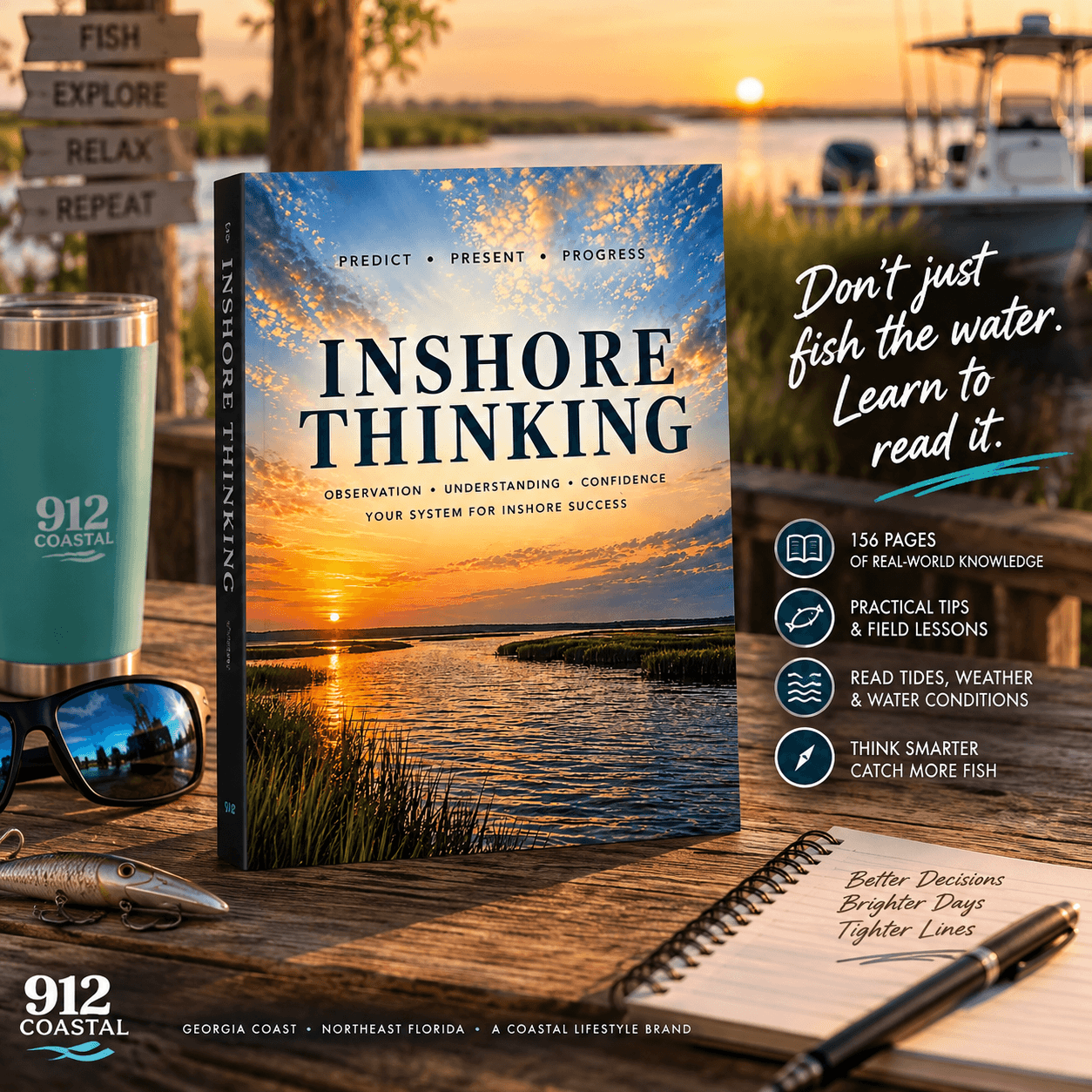
If you want to take this way of thinking even further, explore Inshore Thinking: A Smarter Way to Fish the Georgia & Northeast Florida Coast.
Because once you learn to read the water, you don't just fish a spot anymore. You understand it.
Explore More 912 Coastal
Fishing Tips — Practical techniques and ideas to help you become a better angler.
Fishing Reports — See what's happening on the water and what's changing with the seasons.
Gear Reviews — Learn about the equipment that helps you put your fishing plan into practice.
St. Marys Fishing — Explore one of our home waters and the fishing opportunities around the area.
Kayaking — Discover another way to get into shallow coastal water.
Boating — Explore the boating side of coastal fishing and getting on the water.
Fishing Charters & Trips — Sometimes the best way to learn new water is to spend a day with someone who knows it.
Coastal Living — Because there's more to life on the coast than fishing.
Explore. Fish. Relax. Live Coastal
ABOUT 912 COASTAL
912 Coastal is your home for fishing, boating, and coastal living across Georgia and Northeast Florida. Discover local fishing reports, gear reviews, guides, and coastal adventures.
Tight lines, and welcome to the 912 Coastal community!


Join thousands of anglers and get fishing tips, local reports, new blog posts, gear recommendations, and exclusive 912 Coastal updates delivered to your inbox.